free log
A melting pot of punchy, persuasive copywriting
Call Me: +44 (0)203 2398784

Posts Tagged website conversion rate

Improving Website Conversion Post 8 – Keep Testing to Improve Conversions and Sales

Improving Website Conversion Post 8 – Keep Testing to Improve Conversions and Sales

This is the final part of my series on how to improve the conversion rate of your website using a new tested approach to web design, rather than guesswork and assumptions (if you’re late to the party, you can start at post one or wait for the eBook). From following the previous posts, you should now have a new version of your website built on the solid foundations of analytics, research and testing, rather than wishy-washy guesses and hope. You have every right to believe your new version is ready to take your conversion rate racing ahead. But now is not the time to abandon the use of testing to see whether your assumptions are right. After all, how do you know whether your new website is any better unless you test to find out? Get started in A/B split testing with Google’s Content Experiments When I started writing this series, Google Website Optimizer was to be its crowning glory; a tool worth $1000s you could use for free to keep making improvements to your website. But since the series started, GWO has been chopped down, lobotomized and grafted into Google analytics. Now renamed Content Experiments, it still offers a quick, easy and free way of testing improvements to your website. Just not in as much depth as before. Using Content Experiments you can run up to six versions of your website’s pages at the same time. It will then track the clickthroughs to a ‘goal’ page (e.g. product or contact page) so you can quickly find a winner. This can save you weeks of laborious testing time and it will tell you in cold, hard figures which pages have the highest conversion rate. Keep driving up conversions with multi-variant testing Google Content Experiments provides a quick, easy way of

Read more

Guest Post: Setting Up A/B Testing Correctly

Guest Post: Setting Up A/B Testing Correctly

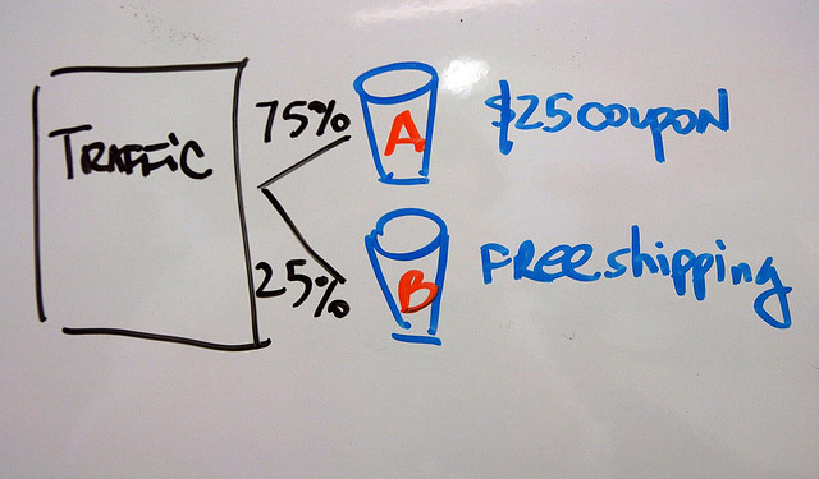
Image courtesy of Mil8 My final post in my own series on the new testing approach to website design still has yet to move from my ‘to do’ list and onto the blog. So to fill the void, here’s a guest post from Corbo and how to run A/B tests correctly for higher conversions and more sales.  If you’re after maximizing your profits to the fullest extent, employing a/b testing is a great way to gauge the efficiency of your business strategy. Here’s how you do it simply and quickly: First of all, you’ll have to decide what factors you want to test on. This can be anything from the popularity of one product over the other to the viability of sales of one branch against the next. After which you’ll have to set up the test to ensure accuracy and efficiency when it comes time to calculate the results. There are a slew of various testing programs that you can use to ensure the precision of the task you’re about to undertake. One of the most popular and user-friendly tools available for a/b testing is the Visual Website Optimizer, a very easy-to-use tool with lots of extras that make testing quick and easy. If you’re a bit savvy with ins and outs of HTML and Javascript, opting for Google’s very own web optimizing tool should be a breeze for you. Of course, there are a myriad of other tools that you can choose from, with Vertser, SiteSpect, and Test & Target by Omniture running the lead. It should be understood that the setup of the whole thing is the same for practically every tool out there, but it is the procedures and how they’re done that decide the final results. Decide on the setup of the test through the following

Read more

Improving Website Conversion 4 – How to stand out from the competition by listening to what customers are saying in social media

Improving Website Conversion 4 – How to stand out from the competition by listening to what customers are saying in social media

This is part 4 of an 8 part series on how to improve the conversion rate of your website using a new testing approach to web design, rather than the old way of guesswork and assumptions Rarely will new customers buy the first time they visit your website. Instead, they’ll browse to see what’s on offer before checking out the competition. With this in mind, it’s vital to analyze your competitors so you can find a way of positioning yourself in a way that makes your offer more appealing, beneficial or unique. Checking out your competitor’s website, downloading their brochure and signing up for their email campaign is a good place to start. That way you can see their online marketing machine in action from the perspective of a customer and see how it compares to yours. In particular, note down the USPs they like to push and where you can differentiate yourself. But in this hyper-connected social media world we now live in, what customers are saying is becoming more important than what businesses say about themselves. Thankfully there are tools you can use to find out. Listen, measure and engage with Radian6 Radian6 is a social media analysis tool that enables you to listen and measure mentions of your brand and those of your competitors in blogs, on Twitter, on YouTube and more. If, for example, you’ve launched a new product or marketing campaign it’s now possible to get real time statistics on the number of social mentions and your campaign’s reach. You can also drill down to read individual mentions and respond to Tweets, comments and blog posts. Responding to people’s comments is great for branding and customer service. But it can also be used to get feedback on your brand or product’s positioning and how it

Read more

Improving Website Conversion 2 – How to identify the leaks that are costing you sales

Improving Website Conversion 2 – How to identify the leaks that are costing you sales

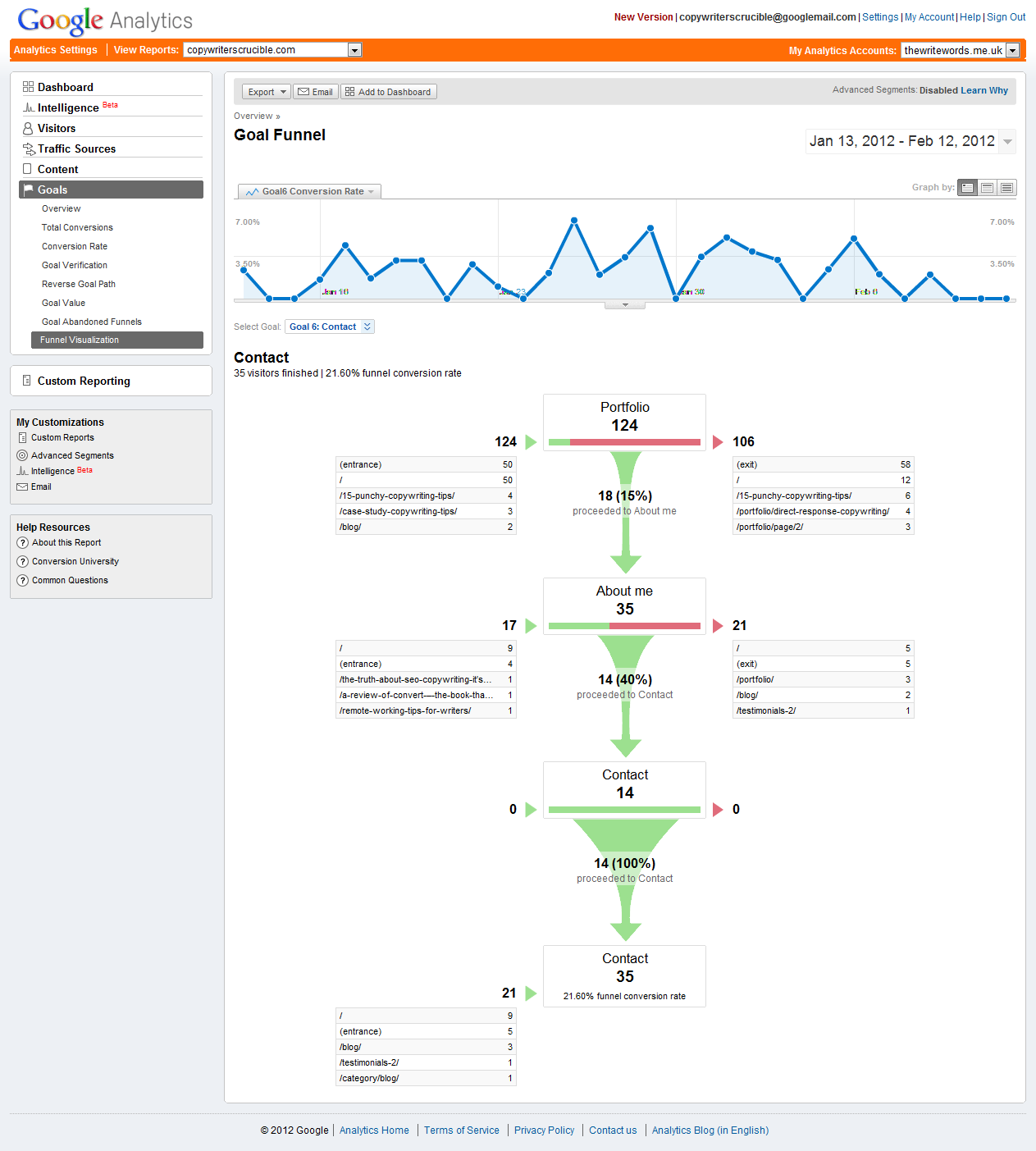
This is part 2 of an 8 part series on how to improve the conversion rate of your website using a new testing approach to web design, rather than the old way of guesswork and assumptions The old approach to web design was a bit knee jerk. If your website wasn’t performing as well as you’d hoped, you’d ditch the entire thing and rebuild it from scratch, hoping a new lick of paint would pull in the crowds. The problem with this approach is that you have no way of knowing which elements of your old design were turning people off and which were nudging them towards the checkout. In fact, a new design could be even worse at converting customers. But without seeing what people were actually doing on your website, you’d have no way of knowing. After all, you can’t improve what you don’t measure. This is why the first step in the new approach to web design is to collect data; primarily info on which pages your customers spend time browsing, which pages push them further through your website and which have them heading for the door. With this information, you can identify which areas of your website you should focus on to improve conversions and sales. Inspect your website’s plumbing Try and imagine your website is a series of pipes which capture people like rainwater and then transport them on a carefully structured route to a particular page or action. As with any system of pipes, you need to identify the leaks (i.e. the pages where customers exit the website) and fix them. This is where Google Analytics comes in. In Google Analytics two simple ways of identifying leaks are: 1)      Bounce rate – This is the percentage of people that leave from the same page

Read more

Latest Posts

Contact

The Copywriter's Crucible
5a Vales Road
Budleigh Salterton
Devon, EX9 6HS, UK

The Copywriter's Crucible
Flat 4
155 Tower Road
Sliema, Malta

Tel: +44 (0)203 239 8784

Email Me

matt@copywriterscrucible.com

Skype Me

Skype: matt_ambrose
My status

Ask Me a Question

Free Marketing and Copywriting eBooks