

Grow Your Subscribers with this Unblockable Pop-up WordPress Plugin
February 18, 2009 | 5 Comments
My persuasive writing eBook is currently in the operating room undergoing surgery.
The different parts didn’t assemble as neatly as I’d hoped. I started off discussing business writing in general but by chapter seven I’d started focusing on sales letter and landing page copywriting.
So I’m now in the process of cutting unwanted material with a hacksaw and implanting fresh words to try and create the eBook I’d planned.
Whilst it’s still on the operating table, I thought I’d investigate how I can use my free eBook to convert visitors into subscribers.
I’ve noticed in recent months that more websites (and not just blogs) are using pop-up subscription boxes to signup visitors to their newsletter or RSS feed.
As every internet marketer knows, few people are going to buy your product or service on the first visit. So you need to be able to maintain contact and build a relationship over time; using a pop-up subscription box makes signing up visitors to receive your content that little bit easier.
Unblockable (for now)
After a brief search, I stumbled upon a free WordPress plugin for creating a subscription pop-up screen.
The MaxBlogPress Unblockable Pop-up plugin is a breeze to install and start using. You simply upload and activate as you would a normal plugin, and then you create your Pop-up within minutes using the straightforward editor.
You can specify your pop-up’s size, how you’d like it to appear and (most importantly) how frequently you’d like it to display.
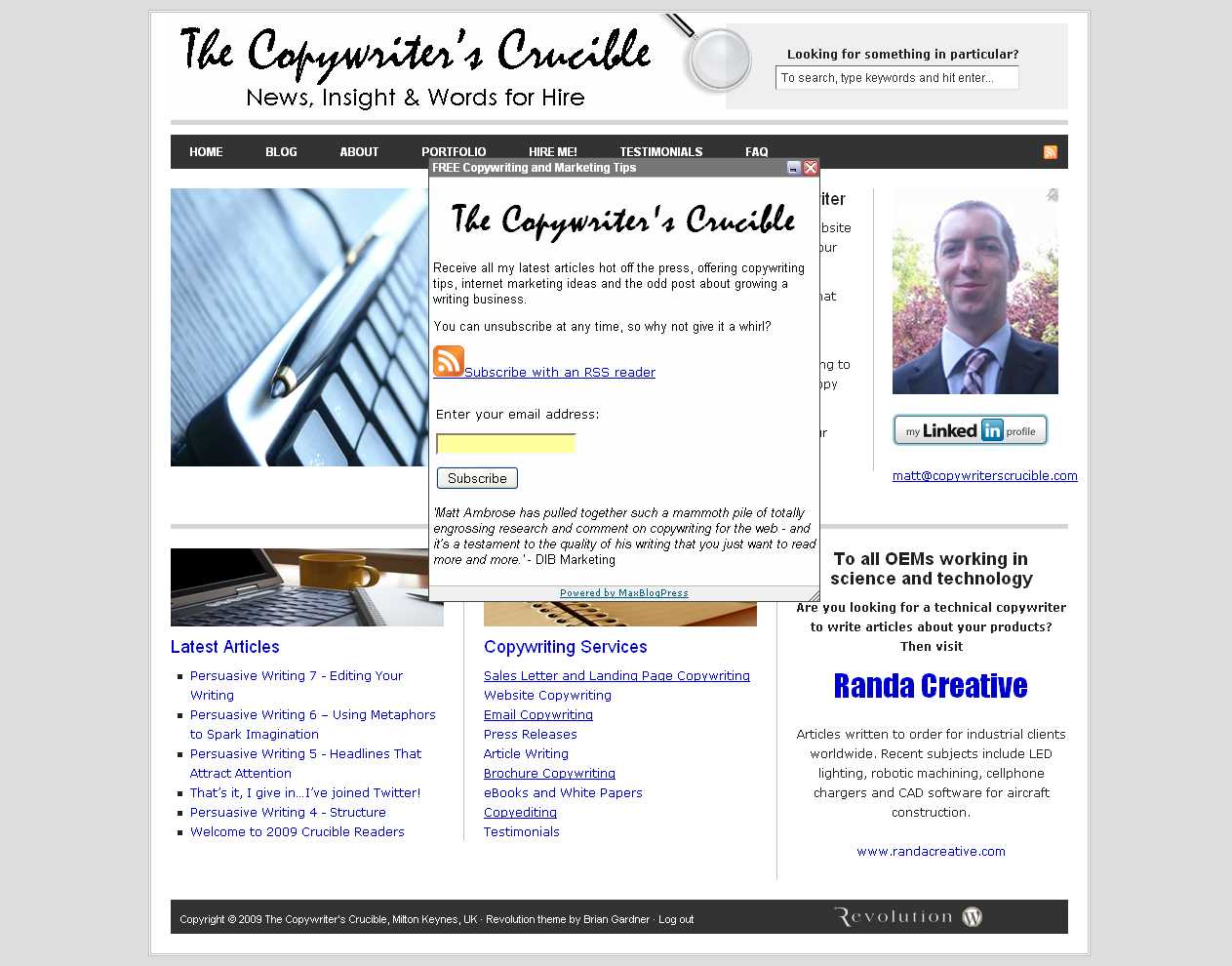
Mine in action:
Whilst the temptation might be to flash up your offer at every opportunity, obtrusive pop-ups can be as annoying as a pushy salesman and risk causing visitors to leave and never come back.
So I’d recommend displaying your ad once or twice and then allow visitors to browse in peace.
Unfortunately I don’t think it’s going to be possible to use the plugin to to give away my eBook without using a separate autoresponder, so I’ll probably just add the eBook as a link in the footer of future posts.
Hopefully if the surgery is successful my eBook will be out of the operating theatre and ready to start seeing visitors next week.
Persuasive Writing 7 – Editing Your Writing
February 11, 2009 | 5 Comments
It’s believed that procrastination and writer’s block are caused by the writer’s desire to achieve perfection.
The fear of composing an awkward sentence or weak turn of phrase can be so paralysing that many writers simply can’t face the simple act of typing words into their keyboard.
But it’s also believed that writer’s block is a myth, because you can always write something.
First drafts can sometimes be a clumsy, repetitive and turgid mass of unrefined words.
But the beauty of a word processor is that you can go over your writing as many times as you like sculpting and moulding it until you’re left with a concisely crafted piece of writing.
This is why editing is so important in the writing process.
Here are my tips for editing your writing until it emerges from your words workshop clean, crisp and able to clearly communicate what you’re trying to say.
1. Read with fresh eyes
After you’ve finished your first draft, stand up and walk away from your keyboard.
Go for a walk, read a book or clean the dishes if you want to.
Just give yourself a break so you can go back later on and read through your writing with more objectivity.
It’s amazing what glaring mistakes or awkwardly worded sentences you’ll miss if you don’t give your brain a chance to refresh and read with a clean slate.
2. Read from the viewpoint of your target reader
Sometimes you might get carried away when you’re writing and use a style and tone that appeals to you. But you mustn’t forget the reader.
So you need to assess whether your writing achieves its objective of projecting an idea, feeling or image onto the target reader’s mind.
Does the tone match their personality type?
Does it risk confusing them with too much technical jargon?
Is it too Corporate? Or too conversational?
Imagine you’re reading your writing for the first time and assess whether it makes sense, holds your interest and presents a convincing argument.
3. Trim and prune
Clear, concise writing comes from brevity and adopting short words and sentences.
So replace long winded language, used to sound impressive, with shorter, punchier versions to instantly make your writing more readable.
You should also consider cutting sentences of over 25 words into two if they can survive on their own.
Also remember that one of your writing’s key aims is to maintain the reader’s attention. So consider the relevance of every single word and phrase.
Wield an axe to flabby, verbose language and refine the remainder with a scalpel until you’re left with a lean, toned and agile piece of writing.
4. Don’t trust Word’s spell check, and use the active voice
Ensure names are spelt correctly, commas are in the right place and you’ve scoured it relentlessly for typos. Reading sentences backwards sometimes helps.
Also check you’re using the right contractions (e.g. ‘you’re’ when you mean ‘you are’), and where appropriate writing in the active voice.
The active voice helps your writing to be concise, punchy and easy to read, and is achieved when the subject performs the action expressed by a verb.
A couple of basic examples:
Active – Matt has finally joined Twitter
Passive – Twitter was finally joined by Matt
Active – Matt will post more messages on Twitter
Passive – There will be more messages on Twitter posted by Matt
The warning signs of passive sentences are forms of be, such as am, is, was, were, are, or been, and frequently when ‘by’ is used to link to the subject after the verb.
However, the passive voice does have its fans, particularly in the scientific and technical writing community. The passive voice helps sentences sound objective and fact based, even if at the expense of being flat and uninteresting.
You can learn more about writing in the active or passive voice here:
http://owl.english.purdue.edu/handouts/grammar/g_actpass.html
5. Print it out, read it out
You might feel confident enough in your analytical ability to dissect your writing on screen.
However, printing it out and reading it aloud in its physical form can provide you with a clearer perspective.
When you’re reading words on the screen your mind can play tricks on you, such as missing out words or letters it feels are superfluous to understanding a sentence’s meaning.
Reading your writing aloud, however, slows your brain down and enables you to register and verbalise every word.
6. Walk away again before you hit publish
When you think you’ve finished get up out of your seat again and take another break.
After allowing your brain to refresh give it another read through, taking into consideration points 1-5, until you’re happy.
The beauty of writing is you can keep editing and refining your words until you can literally feel whether they’ll resonate, engage and persuade readers with your finely sculpted collection of words.
Want some extra internet marketing tips and advice?
Well then, head over to the bda blog for an extra dose of insight on branding, marketing and engaging with the shared passions of your customers:


